The Divine Feminine Rising: All of Creation Is Feminine
There is a memory older than language living in the bones of every woman. A memory of temples carved into mountainsides, of rivers worshipped as mothers, of moons tracked as calendars, of blood understood as sacred. Long before the word goddess was whispered in hushed tones or relegated to mythology textbooks, the Divine Feminine was simply the way the world was understood. She was the soil, the storm, the womb, the grave, and the rebirth that followed.
To speak of the Divine Feminine today is to engage in an act of remembrance — and an act of return.
And here is the truth that ancient mystics knew and modern teachers like Robert Althuis have written so plainly: all of Creation is Feminine. Not just women. Not just goddesses. The entire material world of form — every galaxy, every blade of grass, every institution, every ecosystem, every body — is Her. She is Existence itself, expressing as form. To honor Her is not optional spirituality. It is the foundational law of life.
The Vesica Piscis — Where Creation Begins
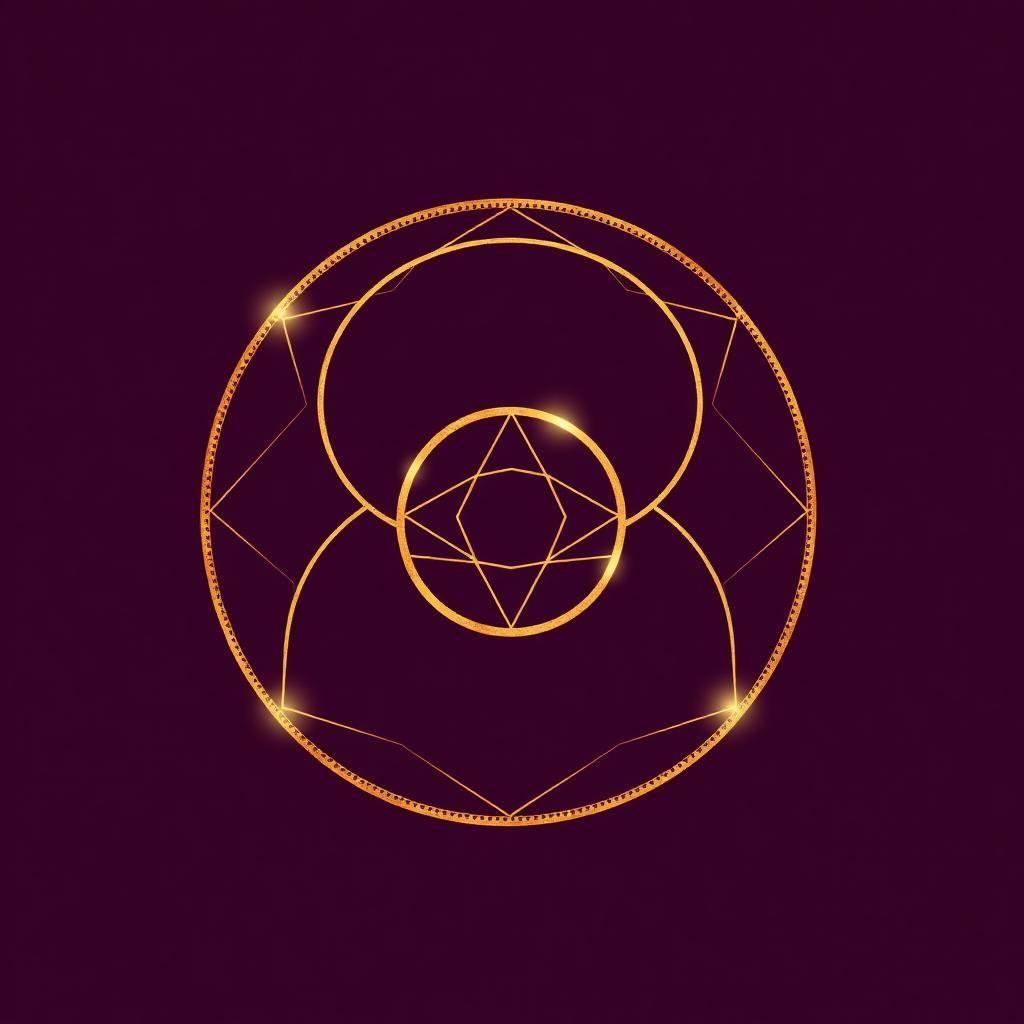
In sacred geometry, two circles overlap and a luminous almond-shape is born between them — the Vesica Piscis, the origin point of all of Creation. It is the womb of the universe. The space where Spirit meets Form. Where the unmanifest becomes manifest. Where the seed becomes the world.
Look closely and you will recognize her shape: the eye, the seed, the flame, the yoni. She is the doorway through which everything that exists has passed. Mathematics knew it. Mystics knew it. Our grandmothers knew it without ever needing the word.
Creation does not begin with command. It begins with opening. With reception. With the holy yes of a womb that says, yes, you may become.
She Has Always Had Many Names
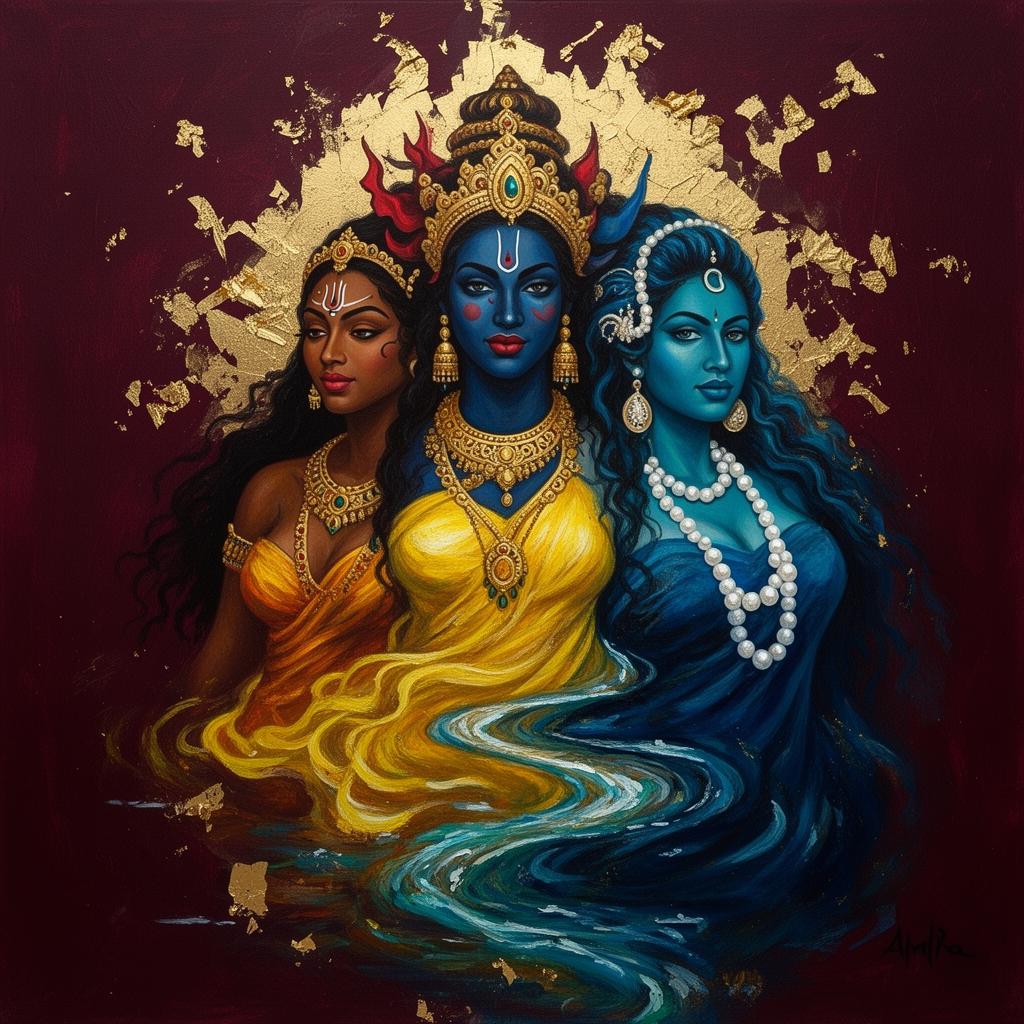
Across continents and millennia, humanity has reached toward the same luminous truth and given Her different names. Each goddess is not a separate deity competing for devotion, but a different facet of one vast, living mystery — the feminine principle that creates, sustains, and dissolves all things.
Kali Ma — The Fierce Mother of Liberation
In the Hindu tradition, Kali Ma stands draped in time itself, her tongue extended, her necklace of skulls catching the light of cremation fires. To the uninitiated she appears terrifying. To her devotees, she is the most tender of mothers.
Kali destroys what is false. She severs the ego, the illusions, the attachments that keep us small. She is the womb and the tomb, the one who reminds us that death is not the opposite of life but its companion. In a world that asks women to be palatable, Kali is a thunderclap of permission: you are allowed to be powerful, to be wrathful in the face of injustice, to burn down what no longer serves the soul.
But Kali is also a warning. She is what the Feminine becomes when she is starved of her sacred fuel source. As Robert Althuis writes: "The wrath of Kali is an immutable force of nature; it literally obliterates everything in its path." When Creation is robbed of love, devotion, and reverence — when the Feminine in any form is treated as something to be controlled or commodified — Kali rises. Hurricanes. Wildfires. Collapsing systems. Burnout. Rage. The collective Kali energy of our time is not a punishment. It is an invoice.
Shakti — The Creative Pulse of the Universe
Where Kali destroys what is false, Shakti is the radiant creative force that pours through all of life when the Feminine is honored. She is the orgasmic, electric, generative current that makes a flower bloom, a child laugh, a song write itself, an ecosystem flourish.
Shakti is what happens when love is poured generously into Creation. The same woman who, deprived, becomes Kali's vessel will, when seen and adored and respected, become Shakti made flesh — radiant, creative, multiplying everything she touches by tenfold. Love it, and it blossoms. Starve it, and it burns.
Oshun — The Honeyed River of Love and Sovereignty
From the Yoruba tradition of West Africa, carried across the Atlantic in the hearts of enslaved peoples and rooted anew in Cuba, Brazil, and the diaspora, Oshun flows as the goddess of fresh water, beauty, fertility, sensuality, and wealth.
But to call Oshun merely the goddess of love is to misunderstand her. She is also the only Orisha who, in one telling, saved humanity when the male deities failed. She is sweetness and strategy, softness and sovereignty. She teaches that pleasure is sacred, that adornment is prayer, that a woman who knows her worth is itself a force of nature. Oshun is Shakti by another name — the proof that what is desired and honored becomes the saving grace of the world.
Yemaya — The Great Mother of the Ocean
Yemaya (or Yemoja, Iemanjá) is the mother of all Orishas, the womb-waters of the world. Her domain is the ocean — vast, holding, ancient, and inscrutable. She is the salt in our tears and the salt in our blood, a reminder that we are, biochemically, walking pieces of sea.
Yemaya teaches what it means to mother without losing oneself, to hold without smothering, to grieve without drowning. For the women of the African diaspora, she has been a tether across the Middle Passage — a mother who followed her children into exile and refused to let them forget who they were.
And So Many More
She is Isis in Egypt, gathering the scattered pieces of Osiris and breathing life back into him. She is Inanna of Sumer, descending into the underworld and returning transformed. She is Pachamama in the Andes, the earth herself. She is Guanyin in East Asia, the bodhisattva of compassion. She is Brigid of the Celts, keeper of the eternal flame. She is Asase Yaa of the Akan, Mami Wata, Lakshmi, Saraswati, Durga, Tara, Sophia, Mary.
Different tongues. Different rituals. The same Mother.
The Cyclical Wisdom of Womanhood
What unites these goddesses across cultures is not iconography but pattern. They embody what every woman knows in her body whether or not she has the language for it: life moves in cycles.
The moon waxes and wanes. The womb bleeds and rests. The seasons turn. We are maiden, mother, and crone — and then, in the dying, we become ancestor, and the cycle begins again. The Divine Feminine refuses the lie of linear progress, the fantasy that we should always be ascending, producing, optimizing. She insists on rest as holy. On grief as fertile. On endings as the precondition of beginnings.
This is power that does not need to dominate to be real. It is the power of the river, which carves canyons by yielding. The power of the seed, which transforms by surrender. The power of the womb, which creates by holding space.
Her Sacred Fuel Source
Every living thing requires fuel. The sun feeds the plant. The plant feeds the body. But the Feminine — and therefore all of Creation — requires a fuel that is more subtle and more essential than any of these. She runs on Love. On reverence. On being truly seen, heard, and desired in the deepest sense of that word — desired not as object, but as the irreplaceable miracle that she is.
This is not sentimentality. It is biology, ecology, and metaphysics in one. A child who is not loved fails to thrive. A river that is not honored becomes poisoned. A woman who is not cherished withers in spirit no matter how successful she appears. A planet stripped of reverence retaliates with fire and flood. The pattern is the same at every scale, because all of it is Her.
To pour love into Creation is to refuel the universe itself. To withhold it is to invite Kali to clean house.
When the Mother Was Honored
There was a time — and the archaeological record is increasingly clear on this — when human societies organized themselves around reverence for the feminine. From the Venus figurines of Paleolithic Europe to the great mother shrines of Çatalhöyük, from the matrilineal clans of the Iroquois Confederacy to the goddess-centered cultures of pre-Vedic India and Minoan Crete, the feminine was not a theological side-character. She was the center.
Matriarchal and matrilineal societies were rarely the inverse of patriarchy. They did not enthrone women to rule over men. Instead, they tended to organize around principles of balance: shared decision-making, descent traced through the mother, land held in common, elders revered, children raised by the village. Power was distributed, not hoarded. The earth was kin, not commodity.
The Long Disruption
The shift did not happen overnight, and it did not happen everywhere at once. But across millennia, through the rise of metallurgy, organized warfare, private property, and institutionalized religion, a new arrangement took hold. Sky gods displaced earth mothers. Conquest replaced communion. Women's bodies — once seen as sacred vessels of cosmic creation — were redefined as property, as temptation, as something to be controlled.
What rose in Her place was not the awakened Masculine, but its wounded shadow. The unawakened masculine, as Althuis names it, "wages wars and degrades into violence, oppression, hate, racism, and blindly indulges in his competitive urges to the extent that unthinkable inequalities and injustices become justified means to the foolish ends of power and control over others."
The witch trials of Europe and the colonies were not random hysteria. They were a systematic dismantling of women's traditional roles as healers, midwives, herbalists, and keepers of communal knowledge. Colonization carried this disruption further, suppressing goddess traditions from the Americas to Africa to Asia. The earth was reframed as a "resource." The womb was reframed as "labor." The wild was reframed as something to be conquered.
And — exactly as the ancient teachings warned — Creation has begun to rebel. The climate is in revolt. Institutions built on extraction are crumbling. This is not random catastrophe. This is Kali, woken by centuries of starvation, beginning her sacred work of obliteration.
The Awakened Masculine
The answer is not the abolition of the masculine. It is its awakening.
Where the wounded masculine controls, the awakened Masculine reveres. Where one extracts, the other honors. Where one demands, the other listens. The awakened Masculine knows that he cannot dominate Creation into harmony, because Creation is Feminine — and the Feminine cannot be tamed; she can only be loved into bloom.
This is not a soft idea. It takes more courage to revere than to conquer. It takes more strength to listen than to command. Women, too, carry this awakened Masculine within. The healing of the world is not a war between the sexes. It is the inner marriage — Shakti and Shiva, Yin and Yang, Earth and Sky — restored within each of us, and then mirrored outward in our families, our institutions, and our planet.
She Is Returning
And yet — She was never truly gone. The Divine Feminine cannot be killed because She is not a belief; She is a reality. She is the menstrual cycle that keeps arriving regardless of what the calendar of capitalism demands. She is the grief that breaks open hardened hearts. She is the moon that pulls the tides whether or not we look up.
We see Her in the Yoruba practitioners restoring the rites of Oshun and Yemaya in Brooklyn and Bahia. In Hindu women returning to fierce devotion of Kali and Durga as feminist practice. In Indigenous women leading movements to protect water and land as sacred kin. In circles of women gathering at new moons, in midwives reclaiming birth from the medical-industrial complex, in trans women claiming their place in the lineage of the Mother, in ordinary women lighting a candle on a kitchen altar and whispering, I remember.
The Rising Is Communal
The Divine Feminine is not a private spirituality, a self-help upgrade, or an aesthetic. She is a politics of relationship — to the earth, to one another, to ourselves. She asks us to heal the splits that patriarchy and colonialism drove through us: between body and spirit, between human and earth, between woman and woman, between feminine and masculine.
She asks white women to listen to Black and Indigenous women, who have carried these traditions through unimaginable rupture. She asks women of every culture to honor the goddesses of their own ancestral lines and to refuse to flatten or appropriate the goddesses of others. She asks us to widen the circle — to include trans women, queer women, disabled women, elder women, young women — because the Mother excludes no daughter.
And to every person reading this — whatever your gender, whatever your story — she asks one simple, world-changing thing: pour love into Creation as if your life depended on it. Because it does. Pour it into the woman in front of you. Pour it into the soil. Pour it into the river. Pour it into the part of yourself you were taught to despise. Pour it into the future you are dreaming of.
A Closing Invocation
If you have read this far, something in you already knows Her. Perhaps you have known Her in a moment of giving birth, or holding a dying parent, or weeping by the ocean, or bleeding under a full moon, or simply standing barefoot on the earth and feeling, for a single breath, held.
She has many names. Kali. Shakti. Oshun. Yemaya. Isis. Inanna. Pachamama. Guanyin. Brigid. Mary. Sophia. The one whose name you do not yet know but whose presence you have always felt.
All of Creation is Feminine — worthy of reverence and deference. She is that exquisite. She is that valuable. It is that simple.
Whatever you call Her, She is calling you back. And we are rising — not above one another, but toward one another — into the great, ancient, unfinished work of remembering who we have always been.
She is here. She is us. She is returning. And She is bringing us home.
With gratitude to Robert Althuis, whose essay "All of Creation Is Feminine" inspired and informed the heart of this piece.
An offering · For all who remember
Leave a note for the circle
Anonymous welcomed. Email is optional — only share if you want to stay close.